
A Landmark Achievement at Lord's
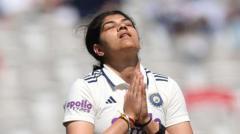
On a recent Monday afternoon at London's iconic Lord's Cricket Ground, Indian cricketer Sneh Rana delivered a pivotal ball, culminating a journey for the Indian women's cricket team that spans five decades. The off-spinner, known for her distinctive bandana, sent a delivery outside the off stump. England's Sophie Ecclestone, fresh from a half-century, advanced, only for the ball to dip, grip, and find its way between bat and pad, dislodging the bails. Rana's skyward kiss and her teammates' jubilant embrace marked the end of England's innings, who were all out for 186. This secured a 270-run victory for India, making it the largest by a visiting team against England in women's Tests and the fourth largest in the format's history.
The celebrations that followed were not solely focused on the present achievement but also served as a profound acknowledgment of the past. Throughout the match, India's players consistently paid homage to the trailblazers who laid the groundwork for women's cricket in the nation, emphasizing that this significant moment belonged equally to them. Fifty years after India participated in their first officially recognized women's international series, Harmanpreet Kaur's squad became the first Indian women's team to achieve a Test victory at Lord's. The match itself was a milestone, marking the first women's Test ever held at the ground, 142 years after Lord's hosted its inaugural men's Test. This triumph occurred four decades after India's maiden women's Test tour of England in 1986 and extended their unbeaten Test record in the country to 10 matches, comprising three wins and seven draws.
Captain's Reflection and Emerging Stars
Harmanpreet Kaur, now India's most successful Test captain with four victories to her predecessor Mithali Raj's three, shared her sentiments with the host broadcaster post-match. "Playing at Lord's is always special," she remarked. "I really want to thank the people who thought about bringing one Test match here. These kinds of matches bring a lot of happiness and excitement. Hopefully, we'll keep getting more Test matches and keep performing the way we are doing." The 37-year-old was participating in only her eighth Test over a 17-year international career, a stark reminder of the limited opportunities her generation received in the longest format. At the pre-match press conference, she reflected on the significance of being present for the occasion: "Maybe it's late but not too late. Still I'm playing and still getting this opportunity to be part of this historic day."
History was also etched in other ways. For the first time, women earned places on Lord's renowned Honours Boards, and both were Indian. On Saturday, 22-year-old seam bowler Kranti Gaud from Ghuwara, a small town in central India, became the first woman to appear on the bowling board after taking five wickets for 37 runs in England's first innings. Gaud's mother had once pawned her jewelry to help purchase one of her initial cricket kits, highlighting the sacrifices made. A day later, Yastika Bhatia, a left-handed batter from Vadodara, another small town in western India, followed suit. Her confident 113, which was the first international century of her career, made her the first woman to score a Test hundred at Lord's and earned her a spot on the batting board. Yet, even in her moment of personal achievement, Bhatia acknowledged the foundational contributions of those who preceded her. "I think they [the pioneers of women's cricket in India] have done an invaluable contribution because Test cricket is, like you said, [been going on for] 50 years," Yastika stated at the post-play press conference. "Their contribution has inspired us to take up cricket and to perform the way we are doing today, so their role is very crucial and they have laid the foundation." She further added that these pioneers had not received the recognition they deserved. "So we should now take a moment to thank them for their contribution and what they have done for Indian cricket, for world cricket, and inspired so many young cricketers," Bhatia urged.
Collective Effort and Historical Context
Kranti and Yastika emerged as prominent figures in a victory where India found a different match-winner in almost every session. Vice-captain Smriti Mandhana set an aggressive tone with a match tally of 153 runs, the highest of the game. Harmanpreet, Deepti, and Richa Ghosh all contributed with half-centuries, while seamer Sayali Satghare bowled with pace, and the spin trio of Rana, Deepti, and debutant N Sree Charani provided crucial control. This triumph came eight months after India secured their maiden senior Women's ODI World Cup in Navi Mumbai and a fortnight after a disappointing T20 World Cup campaign concluded with a group-stage exit at Lord's. Its significance, however, extended much deeper into history.
Organized women's cricket in India originated through the initiative of Mahendra Kumar Sharma, the founding secretary of the Women's Cricket Association of India (WCAI), established in 1973. Sustained largely by dedicated volunteers with limited resources but immense conviction, the WCAI nurtured the initial generations of Indian women cricketers. Three years later, Shantha Rangaswamy from Bengaluru captained India in their first officially recognized international series, a six-Test contest against the West Indies. The series commenced in Bengaluru and culminated with India's inaugural international victory in the fourth Test in Patna. A decade later, India embarked on their first tour of England, participating in three Tests and three ODIs. Shubhangi Kulkarni captained the opening Test at Wetherby, followed by Diana Edulji leading the remaining two at Blackpool and Worcester. Forty years on, Harmanpreet and her pioneering team have preserved India's unbeaten record in England.
Connecting Generations and Future Aspirations
Fittingly, the scorebook served as a bridge between generations: Mandhana became only the second Indian woman after Sandhya Agarwal to score 70 or more runs in both innings of a Test. Rana's fourth haul of four or more wickets in 10 Test innings placed her level with Neetu David, trailing only Kulkarni and Jhulan Goswami. Prior to the match, Harmanpreet acknowledged the profound debt owed to those who came before. "Our seniors have always supported us immensely. No matter how difficult the phases in our lives have been, they have always stood by us. It is because of their support that we have been able to grow so much over the years," she stated. These words resonated as celebrations unfolded before unprecedented crowds. A total of 37,846 spectators attended the match across four days, marking the highest cumulative attendance for a women's Test.
Indian batting legend Sachin Tendulkar was present at Lord's on the final day, exactly 24 years after helping India win the NatWest Series final at the same ground under Sourav Ganguly's captaincy. ICC chairman Jay Shah and several BCCI officials were also in attendance. Yet, despite the presence of many prominent figures, none of India's original pioneers were at Lord's to witness this historic occasion. Through the voices of Harmanpreet and Bhatia, however, their legacy remained central to the narrative. Fifty years after India's women entered international cricket, a journey that began on modest grounds across the country reached its defining moment with a historic Test victory at the Home of Cricket.
Source: How India's Lord's win echoes the legacy of its pioneering women cricketers